
Skin aging: understand everything to better limit the effects of time

17/07/2025

FEMME-SOURIANTE-ASSISE-SUR-UNE-CHAISE

Our skin tells our story. It lives through our experiences and emotions, and evolves over time. Naturally, our skin ages . And it shows: the appearance of wrinkles, sagging, and a less defined facial contour, the formation of spots, a more closed face and a darker complexion... Signs of skin aging that we would like to avoid but which our skin cannot completely resist.
Understanding skin aging is the first step to better combating it and taking care of our skin effectively and kindly.

In this article, we explain everything about skin aging , whether natural or epigenetic, its visible signs, its causes and the factors that accelerate it, as well as our best tips for taking care of your skin despite the effects of time.

Skin aging: a complex natural process

Natural aging and added aging

Skin aging is a natural physiological process characterized by an overall slowdown in skin function. From the age of 20, skin cell activity begins to decline.

And while this phenomenon appears and accelerates with age, it is also encouraged by our environment and lifestyle. Thus, we distinguish intrinsic aging (linked to our biological age) from extrinsic or epigenetic aging . The latter is directly linked to external factors or our lifestyle habits and is added to natural biological aging¹.

Changes in the skin associated with aging

Over time, the skin's functioning gradually becomes less efficient: it renews and regenerates less effectively , and it becomes more vulnerable. These slow but profound transformations affect all three layers of the skin and explain the gradual appearance of visible signs of aging.

  • The aging of the epidermis

    With age, the barrier effectiveness of the epidermis , the outer layer of the skin in direct contact with our environment, decreases. This is caused by two main phenomena²:

    • Slower cell renewal : Keratinocytes renew themselves more slowly and dead cells accumulate on the surface. This is why the complexion generally becomes duller and the skin texture less even.

    • Weakening of the skin barrier : the hydrolipidic film becomes thinner due to the natural decrease in sebum production. The skin becomes dehydrated , drier, prone to tightness , and more sensitive to external aggressions such as cold, wind, and pollution.
  • Aging of the dermis

    Just beneath the epidermis, the dermis provides support, firmness, elasticity, and deep hydration to the skin. Over time, the activity of its key cells, the fibroblasts, diminishes, leading to changes and a depletion of its collagen, elastin, and hyaluronic acid composition.³

    • Collagen breakdown : Collagen synthesis decreases while existing fibers stiffen, leading to a loss of skin firmness and the deepening of wrinkles .
    • Elastin breakdown : fragmented, elastic fibers can no longer ensure the elastic properties of the skin, which then loses its tone. Features relax and the oval of the face becomes blurred .
    • Decrease in hyaluronic acid : Hyaluronic acid contributes to skin density. With less hyaluronic acid, the skin becomes dehydrated and loses density , which promotes the appearance of wrinkles.
    • Slowed microcirculation : Oxygen and essential nutrients are less efficiently delivered to cells, which then lose resources essential for their proper functioning. Overall, the complexion loses its radiance.
  • Aging of the hypodermis

    The deepest layer of skin, the hypodermis is mainly composed of adipocytes (fat cells) which provide essential functions of volume, thermal insulation and energy reserve.

    With aging, subcutaneous fat decreases unevenly. This is why certain areas of the face and body become hollow or saggy. This gradual loss of fat then promotes overall sagging and a loss of skin tone , particularly in the oval of the face, neck, arms and stomach⁴.

Other subcutaneous changes related to aging

Skin aging of the face and body also results from transformations of the deep structures — muscles and bones — which support the skin and modulate its appearance over time⁴.

With age, atrophy and loss of muscle tone contribute to the sagging of facial features , impacting expressiveness and accentuating the visible signs of skin aging.

Facial bone loss also changes the geometry of the face (hollowing of the gaze, sagging of the features, less defined oval) and visibly accentuates the signs of skin aging.

Collapsible content

Focus on oxidative stress⁵

Oxidative stress is one of the main mechanisms responsible for premature skin aging . It occurs in the different layers of the skin and appears in the event of an imbalance between the skin's natural antioxidant defenses and free radicals (unstable molecules) naturally produced by the skin and by various factors such as UV rays, pollution, tobacco, lack of sleep, poor diet, etc.


In excess, these free radicals act on several levels:

  • They attack skin cells and their DNA,
  • They damage collagen and elastin ,
  • They weaken the skin barrier ,
  • They promote silent inflammation , also called “inflammaging.”

Overall, oxidative stress promotes the deepening of wrinkles, sagging skin, a dull complexion, and skin that is more sensitive to external aggressions.

By affecting the skin, fat, muscles and bones, aging therefore appears multidimensional . The transformations of these different internal components have an impact on the surface of the skin, with the appearance of visible signs of aging.

The visible signs of skin aging

We'd rather not see them, but the signs of time are gradually appearing on our faces and bodies. Here are the main signs of skin aging ⁶.

FEMME-QUI-MONTRE-UNE-FORMATON-DE-RIDE-SUR-SON-FRONT

The deepening of wrinkles

Forehead wrinkles, crow's feet, frown lines, or even "barcode" wrinkles around the lips... you've probably noticed these different expression lines on your face. While they appear from the age of 25-30 due to repeated muscle movements, these wrinkles become more established and deeper over time . The cause? The loss of skin density and elasticity, which no longer allows the folds to smooth out naturally.

Other structural wrinkles also mark the face, such as the nasolabial fold (framing the nose to the mouth), and the bitterness folds (around the mouth). On the body, we can mainly observe horizontal wrinkles on the neck and vertical wrinkles on the décolleté.

FEMME-QUI-MONTRE-SA-PAUPIERE-DU-DOIGT

Sagging skin

The reduction in collagen and elastin, and the melting of the fatty layer, leads to sagging skin that is particularly visible in:

  • Of the oval of the face (jowls, double chin),
  • Upper eyelids, which may become droopy,
  • Cheekbones , which become less prominent.

Overall, this sagging gives the face a sunken appearance, a sad expression and a tired look.

Loss of density

Over time, the skin becomes thinner and less plump under the fingers . Its dermis becomes depleted of collagen and elastic fibers. Its extracellular matrix diminishes, particularly with the loss of hyaluronic acid. This phenomenon is also accentuated in women after menopause , due to the decline in estrogen.

The loss of skin density accentuates the visible effect of sagging skin , particularly at the temples, cheeks or around the eyes.

FEMME-PEAU-NOIRE-AVEC-TACHES-PIGMENTAIRES

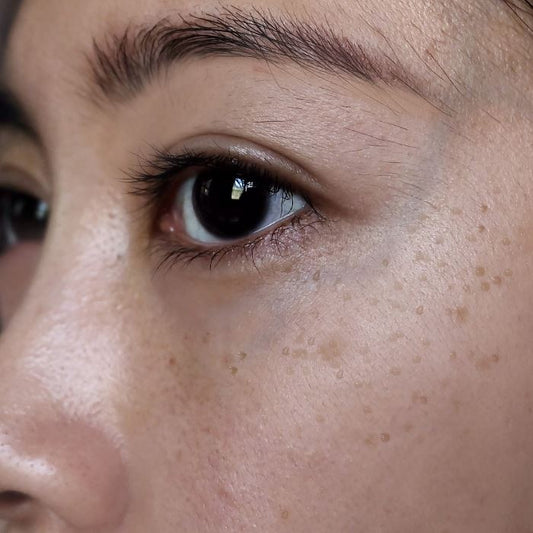
Pigmentation spots

With age, the skin's pigmentation mechanism functions less well , explaining the appearance of visible pigment spots and irregularities on the surface of the skin and a duller complexion:

  • The number of melanocytes decreases ,
  • Melanin production is reduced and less regular ,
  • And its distribution in the epidermis is less homogeneous .

In addition to this intrinsic aging effect, there is generally the impact of UV rays accumulated over the course of our exposure, which promote the appearance of hyperpigmentation , on the face as well as on the body.
Loss of radiance and evenness of complexion

In addition to the alteration of the skin pigmentation process, microcirculation slows down , impacting the radiance of the complexion. With a reduced oxygen supply, the skin becomes less luminous, less rosy .

In addition, due to the poorer cell renewal in the epidermis, the skin texture becomes irregular , the pores more visible, and the skin surface less smooth.
Added to this may be diffuse redness which also impacts the uniformity of the complexion.

External factors that accelerate skin aging

Beyond the passage of time, certain elements of our environment and our lifestyle accelerate the appearance of the signs of aging . These epigenetic factors act silently by causing significant oxidative stress disrupting the skin's natural functions of protection, regeneration and hydration⁶

  • UV rays and solar aging, the number 1 factor

    It is estimated that 80% of premature skin aging is caused by repeated unprotected sun exposure.
    UV rays induce a massive production of free radicals that damage collagen and elastin fibers , leading to wrinkles and sagging. They also promote inflammation, but also an irregular production of melanin, which promotes hyperpigmentation.

  • Chronic stress

    Stress increases cortisol, the stress hormone. In the skin, excess cortisol impairs barrier function , disrupts cell regeneration, and promotes inflammation.

  • An unbalanced diet

    A diet that favors industrial dishes , processed foods, rich in sugar and poor in fruits and vegetables, sources of antioxidants, accelerates skin aging . A lack of antioxidants (vitamins A, C, E, etc.) does not allow the skin to defend itself well against oxidative stress , a major factor in skin aging .
    A deficiency in essential fatty acids also weakens the skin barrier , making the skin drier, less supple and more sensitive.

  • Excess sugar or the phenomenon of glycation

    Excessive consumption of refined sugars triggers glycation, a process in which sugar attaches to collagen fibers, causing them to stiffen. This causes the skin to lose its suppleness and wrinkles to appear more easily.

  • Pollution

    By penetrating the epidermis, fine pollution particles (PM 2.5 and PM 10) weaken the skin barrier and induce inflammation. Overall, they damage the skin's constituents (proteins, collagen and elastic fibers, cells, etc.), altering the skin's function.

  • Tobacco

    Tobacco is known to reduce microcirculation , depriving the skin of oxygen, and is also a major source of free radicals. It also promotes dehydration, darkens the complexion, and deepens wrinkles , especially those around the mouth.

  • Lack of sleep

    Skin repairs itself during the night. Thus, lack of sleep disrupts the skin's regeneration mechanisms essential for limiting skin aging.

  • Blue light

    Coming from our many screens (smartphones, computers, tablets), blue light penetrates deep into the skin. It induces oxidative stress , which damages cells and alters radiance , and also promotes the appearance of disorders and pigmentation spots.

How to take care of your skin to slow down aging?

There are many signs of aging, but the good news is that there are solutions and appropriate care practices to prevent and limit their onset and appearance.

A tailored skincare routine

Opt for anti-aging treatments

Specifically developed to limit the impact of skin aging, anti-aging treatments generally target the skin's regeneration mechanisms (collagen synthesis, protection of elastic fibers, hydration) and fight against oxidative stress, pigmentary disorders and even glycation.

To help you choose the right treatments, here are some of the best anti-aging active ingredients , each with different mechanisms of action:

  • Hyaluronic acid : It captures up to 1,000 times its weight in water and activates the natural synthesis of hyaluronic acid. Existing in different forms, it helps to plump, hydrate and smooth the skin.
  • Vitamin C : an antioxidant, it strengthens the skin's natural defenses against free radicals.
  • Peptides : they act on different mechanisms involved in skin aging (stimulation of collagen production, protection against free radicals, reduction of micro-contractions of the skin to smooth wrinkles, etc.).
  • Retinol : It stimulates cell renewal and collagen synthesis , reduces wrinkles, pigment spots and the visibility of pores.
  • Niacinamide : This active ingredient has been proven to increase collagen production , improve elasticity, strengthen the skin barrier, but also reduce inflammation and even out the skin.
  • Antioxidants : such as vitamin E or polyphenols, protect against oxidative stress , strengthen the skin's natural defenses, and slow down aging.

The Topicrem answer:


To target the signs of aging and meet the needs of mature skin , discover our AH3 anti-aging skincare range . With its daily serums and creams formulated with different forms of hyaluronic acid, vitamin C and peptides, it offers a complete anti-aging routine for the face.

Adapt your skincare routine according to the evolution of your skin

  • If your skin becomes more sensitive , then opt for treatments specially designed to soothe hypersensitive skin.
  • If your skin becomes drier , choose richer treatments for dry to very dry skin.
  • If spots appear , apply specific treatments that reduce spots and even out the complexion.

The Topicrem answer:

For hyperpigmentation, discover our MELA Hyperpigmentation face and body range . With its unique MELA Complex (algae extract + niacinamide), it targets melanin production to prevent the appearance of new spots and even out skin tone.

Protect your skin from UV rays

Your skin is exposed to the harmful effects of UV rays all year round , even in the city. SPF protection helps reduce their impact.

The Topicrem answer:

To effectively protect your skin from UV rays, discover our SUN PROTECT face and body range .

Hygiene of life and diet

  • Favor a balanced diet , rich in antioxidants, omega-3, zinc and B vitamins.
  • Drink enough : 1.5 to 2 liters of water per day.
  • Take care of your sleep because cell renewal is particularly active at night.
  • Reduce your stress to limit the aging it promotes.
  • Ban harmful substances like sugar, tobacco and alcohol which accelerate skin aging.

Skin aging is a natural process , and because each wrinkle tells a story that would be a shame to erase, TOPICREM supports your skin through these changes. To help you experience your skin's aging in a positive and gentle way, we've designed skincare ranges that respect your skin and are adapted to all stages of its development.

TOPICREM formulas have all been designed to provide protective hydration and preserve the skin barrier of sensitive skin for the whole family.

To do this, the laboratory relies on its expertise derived from pharmaceutical excellence:

  • Selection of high tolerance ingredients with proven effectiveness,
  • Development of formulas clinically tested on sensitive skin,
  • Effectiveness proven by science and approved by consumers.

Through the comfort and emotional well-being they provide, our treatments help you feel confident in your skin and in yourself, to better reveal yourself to others, and thus to fully enjoy every moment of life.

Bibliographic references:

¹Zargaran D, Zoller F, Zargaran A, Weyrich T, Mosahebi A. Facial skin aging: Key concepts and overview of processes. Int J Cosmet Sci. 2022 Aug;44(4):414-420. doi:10.1111/ics.12779. Epub 2022 Jul 8. PMID: 35426152; PMCID: PMC9543134.
Link: https://pubmed.ncbi.nlm.nih.gov/35426152/

²Wang Z, Man MQ, Li T, Elias PM, Mauro TM. Aging-associated alterations in epidermal function and their clinical significance. Aging (Albany NY). 2020 Mar 27;12(6):5551-5565. doi: 10.18632/aging.102946. Epub 2020 Mar 27. PMID: 32217811; PMCID: PMC7138575.
Link: https://pubmed.ncbi.nlm.nih.gov/32217811/

³Shin JW, Kwon SH, Choi JY, Na JI, Huh CH, Choi HR, Park KC. Molecular Mechanisms of Dermal Aging and Antiaging Approaches. Int J Mol Sci. 2019 Apr 29;20(9):2126. doi:10.3390/ijms20092126. PMID: 31036793; PMCID: PMC6540032.
Link: https://pubmed.ncbi.nlm.nih.gov/31036793/

⁴Cotofana S, Fratila AA, Schenck TL, Redka-Swoboda W, Zilinsky I, Pavicic T. The Anatomy of the Aging Face: A Review. Facial Plast Surg. 2016 Jun;32(3):253-60. doi:10.1055/s-0036-1582234. Epub 2016 Jun 1. PMID: 27248022.
Link: https://pubmed.ncbi.nlm.nih.gov/27248022/

⁵Rinnerthaler M, Bischof J, Streubel MK, Trost A, Richter K. Oxidative stress in aging human skin. Biomolecules. 2015 Apr 21;5(2):545-89. doi:10.3390/biom5020545. PMID: 25906193; PMCID: PMC4496685.
Link: https://pmc.ncbi.nlm.nih.gov/articles/PMC4496685/#:~:text=Oxidative%20stress%20in%20skin%20plays,stress%20caused%20by%20UV%20irradiation.

⁶Wong QYA, Chew FT. Defining skin aging and its risk factors: a systematic review and meta-analysis. SciRep. 2021 Nov 11;11(1):22075. doi:10.1038/s41598-021-01573-z. PMID: 34764376; PMCID: PMC8586245.
Link: https://pmc.ncbi.nlm.nih.gov/articles/PMC8586245/