Evaluation of a cosmetic product on well-being and emotions

Welcome on our new website !
Tightness, discomfort, feelings of dryness... When skin is not well, it certainly makes its presence known. On the contrary, it grabs our attention, affects our comfort, and over time, can alter our well-being. Thus, caring for one's skin is part of a well-being experience, where skin condition, sensations, and emotions are interconnected.
Advances in neuroscience provide a better understanding of this close link between the skin, the brain, and our emotions. This research shows that applying a cosmetic product does not only involve cutaneous mechanisms but also elicits sensory and emotional responses, directly influencing our well-being.
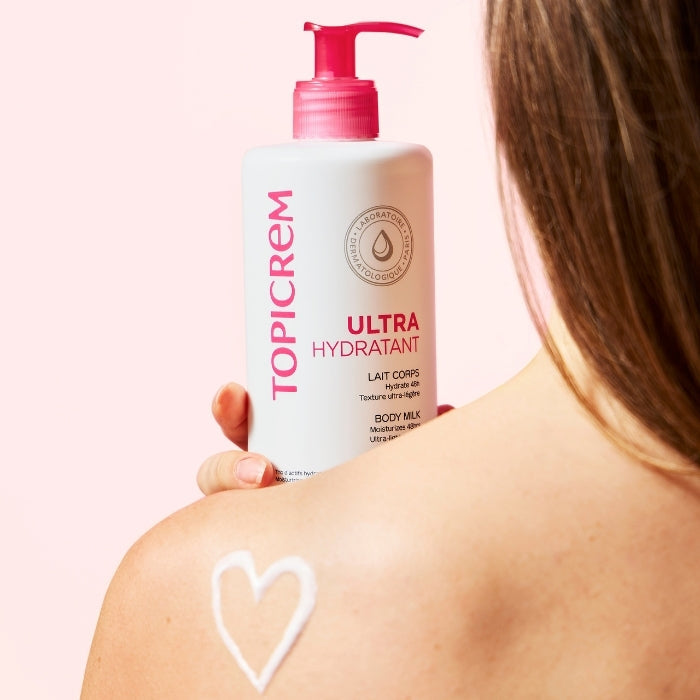
In this article, we explore how neuroscience allows us to evaluate the emotions generated by cosmetic care and why this dimension is particularly important for dry skin, and how, with its unique positioning in Well-Being Dermatology, TOPICREM has integrated this approach. All of this to offer a new enriched formula of its iconic ULTRA-HYDRATING Body Milk, combining moisturizing efficacy and comfort for the dry and sensitive skin of the whole family.
Neuroscience encompasses the various scientific disciplines that study the brain and nervous system. Its objective is to understand how our organism perceives, processes, and interprets information from our environment.
Neuroscience particularly allows us to explore the mechanisms underlying our sensations (such as touch or temperature), as well as our emotions, by analyzing how the brain reacts to external stimuli.
The skin is not merely a physical barrier; it is truly a sensory organ in constant connection with the brain.
Daily, thanks to its dense network of sensory receptors, it captures numerous stimuli, whether through the texture of a skincare product, the coolness of a fabric, the warmth of the sun, or physical pressure...
All these sensations are then transmitted to the brain, where they are interpreted and associated with perceptions: comfort, softness, appeasement... or, conversely, discomfort and an unpleasant experience.
Thus, skin sensations are never neutral and directly contribute to our emotional experience and overall well-being¹.
To learn more about the dialogue between the skin and the brain, read our full article.
Cosmetic products are primarily evaluated based on their visible effects on the skin: hydration, suppleness, radiance, wrinkle reduction, improved appearance, etc. But today, expectations are evolving, and consumers are increasingly looking for a holistic experience, where their cosmetic care combines effectiveness, sensoriality, and well-being.
Neuroscience has provided a better understanding of the impact of cosmetics on well-being by highlighting the central role of the brain in product perception. When applying a product, physicochemical properties (viscosity, stickiness, shine, etc.) are not the only criteria for satisfaction. Neuroscience research shows that sensory stimuli, such as the application of a cosmetic, activate brain areas linked to pleasure and emotions². These mechanisms explain why the pleasure of application becomes a key criterion: a pleasant product encourages regular use and strengthens attachment to the product.
Thus, the cosmetic gesture goes beyond its initial function and becomes a well-being experience integrated into a daily routine.
The perception of a cosmetic product is based on a combination of sensory stimuli that directly influence how it is felt:
These elements are captured by specialized cutaneous receptors (mechanoreceptors, thermoreceptors), then transmitted to the brain. The brain integrates this information to generate an overall perception and one or more associated emotions.
Studies have shown that certain textures can modulate emotional and cognitive activity. For example, a soft and fluid texture is associated with feelings of comfort and security, while a sticky or greasy texture can generate a feeling of discomfort³.
Touch plays a fundamental role here. It notably activates C-tactile nerve fibers, involved in affective touch, which contributes to the sensation of well-being⁴.
Thus, the sensory characteristics of a skincare product contribute to:
Despite their subjectivity, these different sensations and their emotional translation can now be objectified thanks to tools from neuroscience.
Exploratory work in neuroscience highlights the importance of the emotional dimension in the application of a cosmetic product. Specifically, it appears that we integrate a pleasant-to-use skincare product more easily and lastingly into our daily routine. The pleasure of application then becomes a guarantee of regular use, an essential criterion for caring for the skin and promoting visible results.
Cosmetics are thus part of a more holistic vision: taking care of your skin also means giving yourself a moment of well-being, where efficacy and sensoriality combine.
Neuroscience enables us to analyze our emotional reactions using innovative tools. It is even possible to detect emotions that we do not consciously express. Here are some of the most commonly used methods for assessing well-being when using a cosmetic product.
Our face can experience micro-expressions: very rapid and involuntary movements that reveal spontaneous emotions (pleasure, surprise, discomfort, etc.). Facial recognition technologies can identify these fleeting reactions from the first few seconds, capturing an authentic and immediate emotional response to the application of a product.
Certain emotions are accompanied by measurable physiological reactions such as:
These indicators make it possible to evaluate the intensity of the feeling, whether positive (pleasure, relaxation) or negative (stress, discomfort).
Electroencephalography (EEG) measures the electrical activity of the brain in real time. It can be used to identify:
EEG provides a detailed reading of the cerebral mechanisms involved in sensory experience.
In addition to neuroscientific measurements, consumer usage tests are used to gather users' subjective feelings. These tests can use several methodologies:
Participants qualitatively answer questions about the sensations they experience after application: comfort, softness, feeling of tightness or soothing... This data makes it possible to translate the experience into concrete and understandable perceptions.
Standardized tools (visual analogue scales, satisfaction scores, Quality of Life Index - DLQI) can quantify various parameters related to the feeling after applying a cosmetic product: the level of skin comfort, the feeling of well-being, the pleasure of use, the quality of life... These scales facilitate comparison between products and objectify subjective feelings.
Dry skin results from an imbalance in the hydrolipidic film and a lack of lipids, weakening the skin barrier and limiting its ability to retain water. Thus, dry skin experiences increased dehydration and greater vulnerability to external aggressions.
On a daily basis, people with dry skin experience tightness, a "cardboard-like" and rough feeling, and a lack of suppleness.
Dry skin is also often more sensitive, with the possible appearance of redness, tingling or irritation.
All these manifestations contribute to more or less chronic discomfort, and are generally accentuated by cold, wind or after washing⁵ ⁶.
To determine if you have dry skin and how to recognize it, read our full article.
Beyond its physical manifestations, dry skin can have a significant impact on emotional well-being and overall quality of life. Daily discomfort can arise from sensations of tightness or irritation, disrupting everyday activities. The skin "makes itself felt," demanding our attention and potentially becoming an obsession.
These various sensations can impair comfort and quality of life. Uncomfortable skin can limit certain activities, influence clothing choices, or even disrupt moments of relaxation. This can significantly affect our overall well-being. And 82% of people suffering from dry skin report that their condition affects their psychological well-being⁷.
Finally, as we have mentioned, the skin is closely connected to the nervous system. Thus, the sensations it transmits activate the autonomic nervous system. This influence affects our physical state, and its impact can be measured by an increase in heart rate and body stress. This is compounded by an emotional impact, including irritability, a feeling of psychological discomfort, and anxiety.
At TOPICREM, we advocate for Well-being Dermatology to restore smiles to all skin types, even the most sensitive, through dermo-cosmetic solutions that combine effectiveness, safety, and pleasure of application. As part of this approach, we wanted to evaluate the well-being dimension provided by our ULTRA-MOISTURIZING Body Milk, particularly for dry skin prone to discomfort.
Beyond the moisturizing efficacy of our new ULTRA-MOISTURIZING Body Milk formula, we wanted to measure, using neuroscience, the comfort it can bring to dry skin lacking well-being.
To do this, we conducted a clinical study on 33 individuals with dry skin, evaluating 3 emotional parameters associated with the application of ULTRA-MOISTURIZING Body Milk:
In addition to providing excellent hydration with +97% hydration in 1 hour A and +103% hydration after 8 hours A, ULTRA-HYDRATING Body Lotion fulfills its promise to comfort dry skin lacking well-being, and evokes positive emotions.
Upon first application, women feel the difference: for 90% B of volunteers, ULTRA-MOISTURIZING Body Milk provides immediate comfort. This was demonstrated in a satisfaction questionnaire coupled with an instrumental clinical study conducted on 33 volunteers.
Beyond immediate comfort, we wanted to gather physical and emotional sensations associated with the application of ULTRA-HYDRATING Body Milk. We therefore asked volunteers to express their feelings upon application. Their words were simple but telling: they spoke of a "fresh", "light", "pleasant", "soft" formula, providing "comfort", a "cocooning texture" B. All these verbatim evoke comfort.
While our words speak volumes about our well-being, other unconscious parameters testify to our feelings. For example, prosody (voice variations) and our tone of voice can vary. We studied these parameters using a model that analyzes the intensity of an emotion and its positive/negative dimension. The results obtained are unanimous: through their voice, 100% of the people who tested ULTRA-MOISTURIZING Body Milk expressed a positive emotion imbued with relaxation B.
But the experience doesn't stop there. Because well-being is expressed through words, perceived through unconscious signals, but it can also be measured in the brain. Thus, we observed, at the cerebral level, the well-being brought by ULTRA-MOISTURIZING Body Milk, by measuring the electrical activity of the brain and its different waves indicative of mental states (wakefulness, relaxation, concentration...). And the electroencephalograms performed after the application of the product showed it: applying ULTRA-MOISTURIZING Body Milk is associated with calm, relaxation and well-being, by promoting the emission of alpha waves B.
This cerebral well-being is confirmed even in autonomous physiological reactions. A complementary measurement of heart rate variability allowed to go further by evaluating the physiological emotional state of people after application. And after using the ULTRA-MOISTURIZING Body Milk, 100% of volunteers showed, in a physiological and uncontrolled way, through their heart rate, a more positive and relaxing emotion (+37%) B.
Overall, our brand new ULTRA-HYDRATING Body Milk offers persistent high hydration for up to 48 hours A after a single application. But, above all, it stands out by providing dry skin with real comfort, felt from the first application, and expressed by those who tested it A, B.
Advances in neuroscience allow us to better understand the impact of a cosmetic on our well-being. Specifically, the performance of a skincare product is not limited to its visible effectiveness, but also relies on the sensations and well-being it provides.
At TOPICREM, this is precisely our vision of DermoCosmetics: because we believe that happy skin means more overall well-being every day, we have been driven for nearly 30 years by our approach to Well-being Dermatology. Our skincare products aim to bring a smile back to all skin types, even the most sensitive, by meeting their various needs, while offering them sensory and comforting experiences.
Our new reinforced ULTRA-HYDRATING Body Milk formula illustrates this conviction by combining hydration, comfort, and application pleasure, to transform a daily gesture into a true moment of softness and well-being.
TOPICREM formulas have all been designed to provide protective hydration and preserve the skin barrier of sensitive skin for the entire family.
To achieve this, the laboratory relies on its expertise derived from pharmaceutical excellence:
Through the comfort and emotional well-being they provide, our skincare products help you feel confident in your skin and in yourself, allowing you to fully enjoy every moment of life.
Regulatory disclaimers:
[A] Instrumental test on 20 subjects.
[B] Clinical study on 33 subjects immediately after the first application.
Bibliographical references:
¹Schmelz M. Neuronal sensitivity of the skin. Eur J Dermatol. 2011 May;21 Suppl 2:43-7. doi: 10.1684/ejd.2011.1265. PMID: 21628129.
²Rolls ET. The affective and cognitive processing of touch, oral texture, and temperature in the brain. Neurosci Biobehav Rev. 2010 Feb;34(2):237-45. doi: 10.1016/j.neubiorev.2008.03.010. Epub 2008 Apr 3. PMID: 18468687.
³Guest, S., Ma, A., Mehrabyan, A., Essick, G., Hopkinson, A., & McGlone, F. (2012). Perception of fluids with diverse rheology applied to the underarm versus forearm skin. Somatosensory & Motor Research, 29(3), 89–102. https://doi.org/10.3109/08990220.2012.686937
⁴McGlone F, Wessberg J, Olausson H. Discriminative and affective touch: sensing and feeling. Neuron. 2014 May 21;82(4):737-55. doi: 10.1016/j.neuron.2014.05.001. PMID: 24853935.
⁵https://hal.univ-lorraine.fr/hal-03298126v1/file/BUPHA_T_2020_THOMAS_MELANIE.pdf
⁶Lodén M. Role of topical emollients and moisturizers in the treatment of dry skin barrier disorders. Am J Clin Dermatol 2003;4:771-88.
⁷https://professional.cetraben.co.uk/educational -resources/bsf -survey/
What are the best moisturizing active ingredients for the skin? Glycerin, urea, hyaluronic acid, ...
Read the article
Comprenez le rôle des humectants, émollients et occlusifs pour mieux hydrater votre peau. Conseil...
Read the article
Understanding the skin barrier, its protective role and its structure to preserve skin hydration,...
Read the article
In this article, you will find everything you need to know about skin, to better decode and under...
Read the article