Skin inflammation: understanding its mechanisms and effects on the skin

25/06/2026
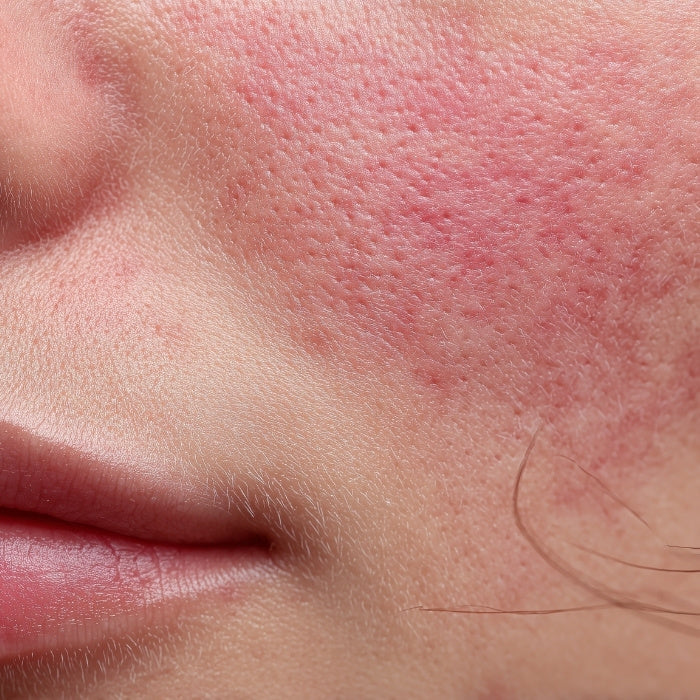
Une inflammation cutané sur la joue

Redness, overheating, blemishes, itching, hyperpigmentation spots or skin discomfort... These manifestations often have one thing in common: skin inflammation.


Natural and essential for skin protection, skin inflammation is a normal biological response of our body to aggression. But when it becomes excessive, repeated or persistent, it can be associated with skin manifestations such as pimples, spots, skin sensitivities or eczema.

So, what happens when the skin becomes inflamed? Why are certain skin conditions particularly associated with inflammation?

In this article, we explain skin inflammation, its mechanisms and its involvement in different skin conditions.

What is skin inflammation?

Inflammation: The Skin's Natural Defense Response

Cutaneous inflammation is a natural biological mechanism triggered by the skin in response to aggression. The function of this phenomenon is primarily protective: inflammation recognizes danger, helps limit damage, and promotes skin repair¹.

This reaction can be triggered by various factors. Our environment can be the cause, whether through the impact of UV rays, pollution, or the climate in which we live (heat, cold, wind).

Some of our daily beauty routines (aggressive cleansing, excessive exfoliation, repeated rubbing, unsuitable products, irritating substances) can also promote inflammation. In addition, our internal state plays a role: stress, fatigue, hormonal variations, allergic reactions, imbalance of the skin microbiota... all these factors can cause the skin to react. Finally, it is common for the inflammatory response to be reactivated by infectious factors such as bacteria, viruses, and parasites.

Skin inflammation is a biological response orchestrated by the cutaneous immune system, which mobilizes to resolve the aggression. In this sense, inflammation is a useful and essential reaction for maintaining skin balance¹.

Visible and Felt Signs of Cutaneous Inflammation

When the skin becomes inflamed, several manifestations can appear, and the skin makes it known. Redness and swelling (edema) very often accompany the inflammatory reaction. Physical manifestations can also be felt, such as tightness, a sensation of heat and burning, itching, and tingling. Overall, skin sensitivity can increase, and sometimes, in the most intense cases, it can cause a sensation of pain.

These manifestations associated with inflammation indicate the activation of the skin's defense mechanisms. Their intensity varies depending on individuals, skin type, and the severity of the aggression suffered.

Acute vs. Chronic Inflammation: What are the Differences?

An acute or punctual inflammation is normal. Rapid, localized, and temporary, it indicates an appropriate response to aggression (excessive sun exposure, irritation, etc.).

But when aggressions are repeated or the skin barrier remains weakened, inflammation can become persistent. This is then referred to as chronic inflammation or low-grade inflammation².

Over time, this prolonged inflammation contributes to weakening the skin and:

  • Making the skin barrier less effective,
  • Promoting skin dehydration,
  • Increasing feelings of discomfort,
  • Causing the appearance of pigment spots,
  • Accelerating skin aging.

The Impact of Chronic Inflammation on Quality of Life

When cutaneous inflammation becomes persistent or frequent, its consequences are not limited to the appearance of the skin but also impact daily well-being.

Some people report significant aesthetic discomfort, a loss of self-confidence, or a tendency to avoid certain social situations when skin manifestations become visible.

Itching or feelings of discomfort can also disrupt sleep, promote fatigue, and increase stress. However, stress itself can contribute to maintaining certain cutaneous inflammatory mechanisms, thus creating a true vicious circle between skin and emotional well-being.

The example of atopic dermatitis (or eczema) clearly illustrates the impact of chronic inflammation on quality of life. Affected individuals report various daily inconveniences³:

  • 43% report symptoms of anxiety or depression,
  • 50% report itching disturbing their sleep, between 5 and 7 nights per week,
  • 63% experience discomfort due to itching for more than 12 hours a day,
  • 44% mention a decrease in their activities and hobbies,
  • And nearly one in two people reports a loss of professional productivity related to itching.

That's why taking care of skin prone to inflammation is not just about improving its appearance, but also about preserving comfort and quality of life on a daily basis.

How does skin inflammation work?

Une coupe de peau qui illustre l'inflammation de la peau

How does skin inflammation begin?

When an aggressor is detected by the skin (UV, pollution, allergens, friction, etc.), certain skin cells, such as keratinocytes and cutaneous immune cells, act as sentinels by identifying the danger and triggering an alert.

Once activated, cutaneous immune cells release various molecules called inflammatory mediators: cytokines (TNF), interleukins (IL-6, IL-8), histamine, prostaglandins, chemokines⁴.
These signals orchestrate the inflammatory response by recruiting defense cells, activating repair mechanisms, and strengthening the skin's protection against aggressions.

Mechanisms of Skin Inflammation

*Vasodilation: Under the effect of inflammatory mediators, blood vessels dilate. This increases blood flow to the affected area and explains the visible signs of inflammation: the skin becomes red, may feel warmer, and sometimes slightly swollen.

*Impaired Skin Barrier: During an inflammatory episode, the skin barrier becomes more permeable. The skin is then more exposed and more sensitive to external aggressions.

*Activation of Repair Mechanisms: Inflammation also plays a key role in the natural skin repair process. In particular, it helps stimulate cell renewal, the production of new cells, and healing mechanisms.

Inflammation is involved in the skin healing mechanism. To learn more about the healing repair process, read our dedicated article.

What are the main signs of skin inflammation?

  • Sunburn: acute skin inflammation

    Sunburn is probably the most common example of acute skin inflammation. UVB rays are the main culprits, causing redness and heat. UVA rays, on the other hand, contribute more deeply to skin photoaging⁵.

    During excessive sun exposure:

    • Skin cells undergo oxidative stress,
    • Inflammatory mediators are released,
    • And the skin reacts with visible inflammation.

    In the long term, repeated inflammation linked to UV exposure contributes to premature skin aging.

  • Post-inflammatory hyperpigmentation spots

    Following inflammation, the skin can produce more melanin, leading to post-inflammatory hyperpigmentation. This phenomenon is linked to inflammatory mediators that stimulate melanocytes, the cells responsible for melanin production⁶.
    The causes of post-inflammatory hyperpigmentation are numerous: pimples, irritation, burns, friction, scars, etc.

  • Eczema: a chronic inflammatory skin disease

    Atopic dermatitis is a chronic inflammatory condition associated with an impaired skin barrier. In practice, atopic skin allows irritants to penetrate more easily and reacts excessively to various environmental factors.
    The inflammation associated with atopic skin explains the common manifestations of this skin disease: redness, itching, discomfort⁷.

    To learn all about atopic skin, read the full article.

  • Hypersensitivity of sensitive skin

    Sensitive or reactive skin has a lower tolerance threshold to external aggressions, meaning that inflammatory mechanisms are activated more quickly⁸.
    Thus, cold, heat, pollution, cosmetics, stress or hormonal variations can trigger inflammation and cause redness, hot flashes and irritation.

  • Skin aging and inflammaging

    Skin aging is a natural phenomenon that appears gradually with age. However, certain external factors such as sun exposure, pollution, and oxidative stress can accelerate it, promoting the appearance of repeated inflammatory reactions in the skin. Over time, this inflammation weakens collagen and elastin fibers, which are essential for skin firmness and tone. The skin then sags, wrinkles deepen, and the signs of aging appear more quickly.

    The term “inflammaging,” a portmanteau of inflammation and aging, is sometimes used to describe this subtle yet persistent inflammation that develops over time and contributes to premature skin aging.

  • Inflammatory acne

    Inflammation plays a central role in acne. When the skin produces excess sebum and pores are blocked, bacterial proliferation and the skin's immune reaction trigger an inflammatory response. This manifests as red, sometimes painful lesions, such as inflammatory pimples (papules and pustules)¹⁰. The more intense or prolonged the inflammation, the higher the risk of post-acne marks (hyperpigmentation).
    Overly aggressive drying treatments can also perpetuate inflammation by further weakening the skin barrier.

TOPICREM, expert in sensitive skin

Understanding the mechanisms of inflammation helps to better identify the skin's needs and adopt more appropriate daily habits. A gentle, moisturizing, and protective routine, combined with skincare products that respect the skin barrier, helps to maintain skin comfort and limit factors that can perpetuate inflammation.

At TOPICREM, expertise in sensitive and fragile skin guides the development of our skincare products. This commitment at the heart of Research & Development allows us to constantly identify and select active ingredients that are effectively soothing for skin inflammation, capable of sustainably improving patients' daily well-being.

Formulas developed for sensitive skin

TOPICREM formulas have all been designed to provide protective hydration and preserve the skin barrier of sensitive skin for the whole family.

To achieve this, the laboratory relies on its expertise derived from pharmaceutical excellence:

  • Selection of high-tolerance ingredients with proven efficacy,
  • Development of formulas clinically tested on sensitive skin,
  • Efficacy demonstrated by science and approved by consumers.

Through the comfort and emotional well-being they provide, our skincare products help you feel confident in your skin and with yourself, allowing you to fully enjoy every moment of life.

Bibliographical references:

¹Stamatas GN, Morello AP, Mays DA. Early inflammatory processes in the skin. Curr Mol Med. 2013 Sep;13(8):1250-69. doi: 10.2174/15665240113139990047. PMID: 23448341.
²Andrzejczak, K.; Sternak, A.; Witkowski, W.; Ponikowska, M. Inflammation-Driven Molecular Ageing in Chronic Inflammatory Skin Diseases: Is There a Role for Biologic Therapies? Cells 2025, 14, 1442. https://doi.org/10.3390/cells14181442
³Dermato-Info.fr (information website of the French Society of Dermatology). Hives.
⁴Narayanan D, Sim SL, Kumari S. Skin immunity and inflammation: cellular interactions and communication. Clin Transl Immunology. 2025 Nov 3;14(11):e70053. doi: 10.1002/cti2.70053. PMID: 41190306; PMCID: PMC12581170.
⁵Bishop T, Ballard A, Holmes H, Young AR, McMahon SB. Ultraviolet-B induced inflammation of human skin: characterisation and comparison with traditional models of hyperalgesia. Eur J Pain. 2009 May;13(5):524-32. doi: 10.1016/j.ejpain.2008.06.006. Epub 2008 Aug 8. PMID: 18691920.
⁶Lawrence E, Syed HA, Al Aboud KM. Postinflammatory Hyperpigmentation. 2024 Nov 25. In: StatPearls [Internet]. Treasure Island (FL): StatPearls Publishing; 2026 Jan–. PMID: 32644576.
⁷Shirley SN, Watson AE, Yusuf N. Pathogenesis of Inflammation in Skin Disease: From Molecular Mechanisms to Pathology. Int J Mol Sci. 2024 Sep 21;25(18):10152. doi: 10.3390/ijms251810152. PMID: 39337637; PMCID: PMC11431851.
⁸Wollenberg A, Giménez-Arnau A. Sensitive skin: A relevant syndrome, be aware. J Eur Acad Dermatol Venereol. 2022 Apr;36 Suppl 5:3-5. doi: 10.1111/jdv.17903. PMID: 35315153.
⁹Agrawal R, Hu A, Bollag WB. The Skin and Inflamm-Aging. Biology (Basel). 2023 Nov 2;12(11):1396. doi: 10.3390/biology12111396. PMID: 37997995; PMCID: PMC10669244.
¹⁰Cruz S, Vecerek N, Elbuluk N. Targeting Inflammation in Acne: Current Treatments and Future Prospects. Am J Clin Dermatol. 2023 Sep;24(5):681-694. doi: 10.1007/s40257-023-00789-1. Epub 2023 Jun 16. PMID: 37328614; PMCID: PMC10460329.

Skin Inflammation FAQ

What is skin inflammation?

Skin inflammation is a natural defense reaction of the skin to an external or internal aggression. It can be caused by UV rays, pollution, certain infections, allergic reactions, or irritations linked to unsuitable products. This biological response allows the skin to protect itself and repair damaged tissues. It often manifests as redness, itching, swelling, or a sensation of heat.

What are the symptoms of skin inflammation?

The symptoms of skin inflammation vary depending on its intensity and cause. The most common manifestations are redness, itching, burning sensations, tingling, or slight swelling of the skin. Some people may also experience increased sensitivity or greater discomfort. These signs indicate the activation of the skin's defense mechanisms in response to an aggressor or an imbalance.

What are the causes of skin inflammation?

Skin inflammation can be triggered by many factors. Among the most common are sun exposure, pollution, cold, heat, repeated friction, or certain irritating cosmetic products. Stress, hormonal fluctuations, allergies, an imbalance in the skin microbiota, or certain infections can also promote the onset of an inflammatory reaction. Each skin reacts differently depending on its sensitivity and overall condition.

How to soothe skin inflammation?

To help soothe skin inflammation, it is recommended to adopt a gentle routine that respects the skin barrier. Using moisturizing skincare products adapted for sensitive skin helps strengthen the skin's natural protection and limit feelings of discomfort. It is also advisable to avoid external aggressors such as UV rays, irritating products, or overly aggressive cleansing, all of which can perpetuate the inflammatory reaction.

Does skin inflammation promote skin aging?

Yes, when it becomes chronic, skin inflammation can contribute to premature skin aging. Repeated inflammatory reactions gradually promote the degradation of collagen and elastin, two essential components for skin firmness. This phenomenon, called inflammaging, contributes to the faster appearance of wrinkles, loss of elasticity, and overall deterioration of skin quality over time.